
A couple of friends at work mentioned I hadn’t posted anything in a while. Fair enough. I’d been writing in a newer category called Writeups and dabbling in some Tech stuff, but the Life writing, the travel posts that started when we moved to Austria, had gone quiet. Maybe because it’s been almost seven years and this is just where we live now. Three of us, anyway. The fourth headed off to university last fall.
When the second or third person asked about it, I started wondering what I actually wanted to say. And what came up wasn’t an update. More of a reflection.
This goes back to 2015, the week before my dad died of lymphoma. Don’t worry. I’m not going to bury you in grief here. But there’s this one day I keep thinking about.
He was in Boston, in the house where I grew up in Newton. He’d bought a condo in San Francisco with my mom, but he loved the East Coast, and he wanted to say goodbye to it before heading back west. So I flew out from San Francisco to spend a few days with him, and we ran his errands together.
The first stop was his gym. The Boston Sports Club in Waltham. He said it would be his last visit. By this point he had lost a lot of weight and was very frail. For a psychiatrist, someone in the business of talking, he didn’t have much to say about this one.
At the club, he went to the pool and did these gentle, bobbing exercises in the shallow end. Other people in the water looked pink and healthy. He just looked tired, his arms moving slowly back and forth like a tranquilized shorebird. There was no trace of the athlete he’d once been.
On the way out, he walked to the front desk and asked to speak to the manager about canceling his membership. The manager, doing his job, asked if there was a reason. “Sure, yes,” my father said. “I am dying of cancer.” The man shuffled around for a form.
The next errand was his final therapy appointment. Most shrinks see shrinks. It’s not just about working their own issues through. It’s also the practice of being a shrink. Talking shop. My dad had been seeing his therapist, Marty, for many years. Thank God for Marty, my mother used to say. She sent him there with homework on more than one occasion.
While they were in their session, I drove my dad’s Camry to Harvard Square to look around. I hadn’t been there in over a decade. I’ll pick you up when you’re done, I told him. I parked, turned off the car, and reached for my keys. No keys. The fob wasn’t with me. It was with my dad. The car had driven fine because it was already running. Now it wasn’t. I was marooned.
So I did the math. Walk back to Marty’s office, get the fob, jog back to the car, drive back before the session ended. I wasn’t going to let my father stand alone on a sidewalk after his last therapy appointment.
Back at Marty’s, I knocked on the office door. He opened it, surprised. My dad was sitting in a chair just inside. I apologized, explained the situation, then stuck out my hand and said I’d heard a lot about him. I also mentioned, for reasons I still cannot fully explain, that I’d had a brief crush on his daughter, Emily, growing up. She’d lived in the neighborhood. Marty paused and told me she was happily married. My dad handed me the fob without comment.
I jogged back to the car, drove to Marty’s office, and pulled up just as the session ended. “Well,” my dad said, settling into the passenger seat, “you had a little adventure.”
I asked if he wanted to drive through Harvard Square, maybe stop at Mr. Bartley’s Burger Cottage, a place that had been on Mass Ave since the 1960s. He was up for it.
To spare him the walk, I double-parked on Mass Ave. Not exactly a low-profile move in Harvard Square. I ran inside, cut the line that stretched out the door, and told the staff my father was outside, too frail to stand. I’d been sprinting around Cambridge for two hours by then and probably looked half-wrecked myself. They took one look at my dad, compared him to the teens and twenty-somethings in line, and sat us down.
Once he was settled, I ran back to the double-parked car and started hunting for a spot. I found one close by and walked back fast so he wouldn’t have to wait.
I shot a short time-lapse video of that walk back. The sidewalk, Mass Ave, the line out the door as I pass, and then my dad’s face looking up from his menu. I was doing a lot of capturing that week. Little moments, just to keep them.
In hindsight, a burger place was not great judgment. The cancer had been wrecking his digestion for months, which was its own kind of misery. He didn’t say anything about it.
After lunch we drove past his old dorm at Harvard, where he’d lived with a track buddy, Roger Perry, during his undergrad. Or maybe we drove past before lunch. I don’t remember. But he had one more stop on his mind. Something he’d been fixating on for days.
The family tree.
Knowing he was dying had made him feel personally responsible for passing on whatever he knew about his ancestry. His father, Norm, had grown up in Canton, Ohio. His parents had met at Case Western in Cleveland. He’d spoken to cousins, researched what he could, and written it all down in a frenzy. Pages of nearly illegible notes, as if he might lose his grip on the information before he could get it to someone else.
He needed to make four copies of the notes. One each for me, my sister, my brother, and his own brother John. So we drove to a Staples on Soldier Field Road.
I knew that stretch of road, though for a different reason. There was no Staples in 1988. What there was, tucked behind a scrubby hill near a radio tower, was the final resting place of my 1971 Chevy Chevelle. I’d sold it to some kid, but when it broke down his father drove it back to our house, threw the keys at me, and demanded the money back. I didn’t want to pay for a junk yard, so my friends and I drove it up there and left it. The hill was known to us as Chevelle Hill after that. Among a small group of people who are now in their 50s and don’t think about it very often.
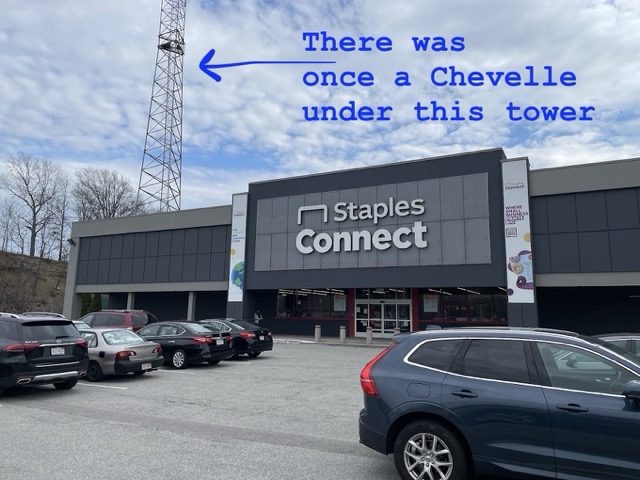
While my dad made his copies inside, I scrambled up the grassy slope next to the parking lot to look for the car. He never knew we’d abandoned it up here. I’d bought it for seven hundred dollars, a price I settled on to spare myself the guilt of asking for more. My parents never got in it. No seatbelts, a rusted gas tank that filled the cabin with fumes, and somehow I was trusted to sort that out myself. He didn’t know I was up here now, either. The road we’d driven up was gone, buried under the parking lot. There was an overgrown patch of brush, a small homeless encampment with a tent and a fire ring, and a few flattened areas where high school kids probably still gathered to drink and get high, as we had at that age.
I jogged back down the hill as my dad came through the door, looking pleased. He was holding four envelopes. Each one labeled by hand: Matt. Suzie. Jacob. John. He handed mine over like it was a ceremony.
His shoulders dropped about an inch. He got back into the passenger seat, closed his eyes, and said: so now that’s done.
A week later, back in San Francisco, he drank enough morphine to die while my sister played him classical music. His last words were oh, that feels good. It took about eight hours. Every fifteen minutes or so his body would let out this reflexive moan, an agonal breath that surprised us each time it came. Then the intervals stretched, and it stopped. He should have taken more.